See where AI usage is real, where operating leverage is not, and what to fix first.
Most leadership teams know AI is being used. Far fewer can show where it is improving workflows, where risk is quietly increasing, and which operating bottlenecks deserve attention first. AI-Q gives referred operators and advisors a fast way to triage that.
Start the AI-Q AuditHow the AI-Q process works
Step 1 — AI-Q audit
- Start with a 10-minute assessment to see where AI is creating leverage and where it is not.
- Invite a subset of teams first or expand to the full operating group.
- Get an early dashboard view as responses come in.
Optional first step — Executive scan
- Use it when you want a quick directional read before inviting the team.
- Get a leadership hypothesis on readiness, bottlenecks, and governance risk.
- Then move into the full audit without starting over.
What leadership actually gets
Directional operating read
See your likely AI-Q band, top bottlenecks, and where operating drag is probably concentrated.
Governance and risk signal
Spot likely tool sprawl, policy gaps, and weak controls before they become a board-level problem.
Workflow priorities
See which workflows appear most worth validating next, rather than getting a generic maturity score.
What this is and what it is not
This is
- A fast leadership triage for referred operators, advisors, and investors.
- A directional hypothesis about where AI leverage and risk are likely showing up.
- A way to decide whether a full team audit is worth running now.
This is not
- A final benchmark produced from five answers alone.
- A substitute for team workflow evidence.
- A promise of exact savings before the audit validates what is really happening.
Trust and data handling
What to expect
- Your workspace is created for your organization and can be recovered later with the same company details.
- The scan is meant for directional operating judgment, not sensitive customer or regulated data.
- If you were referred into AI-Q, be explicit internally about who should see the results.
What AI-Q looks at
- Workflow patterns, not just tool names.
- Examples include ChatGPT, Claude, Gemini, Cursor, GitHub Copilot, Sana.ai, Lovable, and internal copilots.
- The audit is designed to surface where AI is embedded in recurring work and where it is still ad hoc.
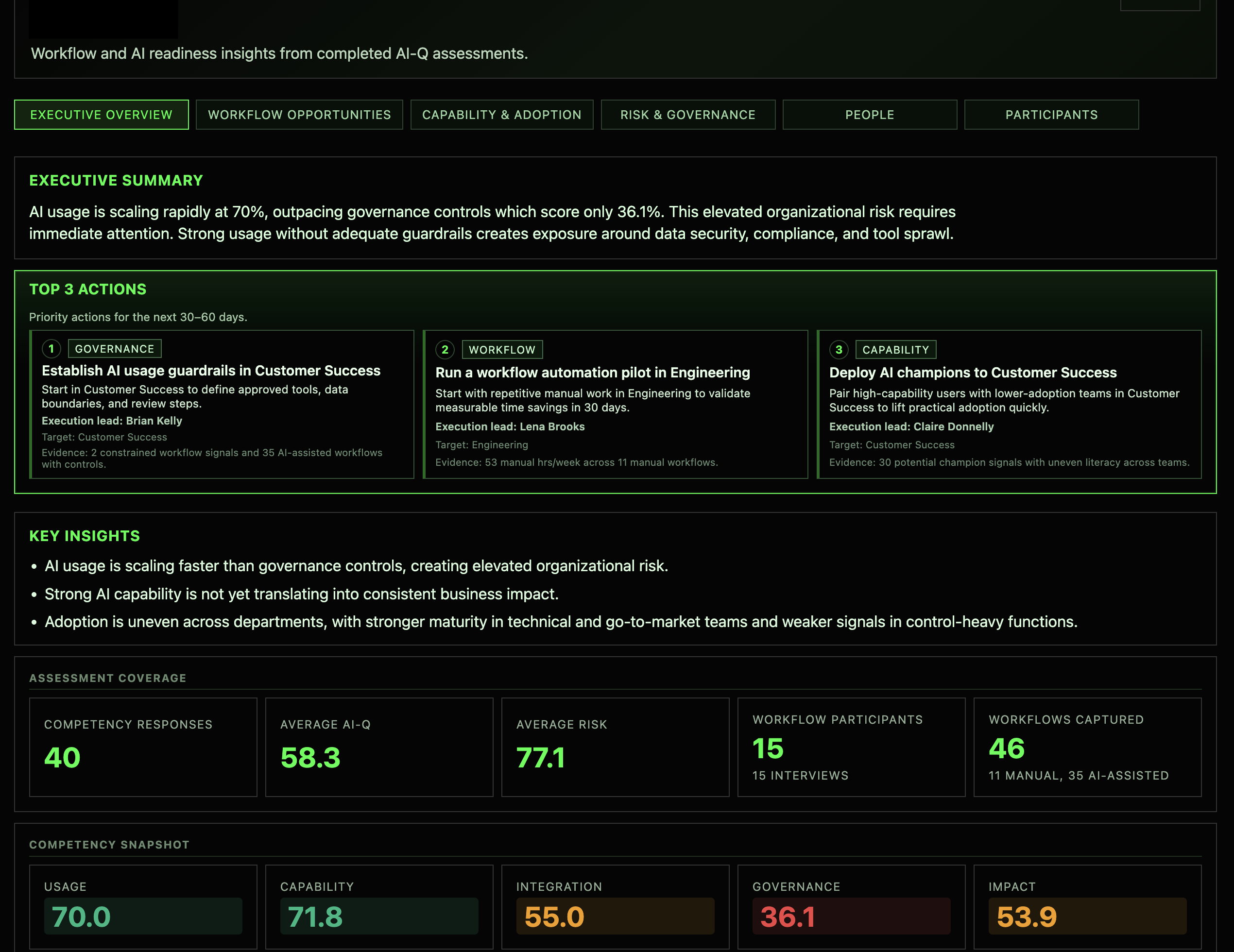
The dashboard shows where to act, why it matters, and what to validate next
Executive Overview screenshot
See where to act, which workflows need validation, and where ownership should sit.
What happens after the scan
- You get a directional snapshot of likely bottlenecks, governance risk, and top actions.
- You can go straight into the full audit without re-entering the company context.
- The audit shows where adoption is creating leverage, bottlenecks, or uneven results across the team.
- Most teams then run the workflow diagnostic to identify automation opportunities and quantify recoverable time.
Audit journey
Executive scan (optional)
Get a quick leadership-level read on AI usage, likely bottlenecks, and governance gaps.
Launch the audit
Start with a subset of teams or invite the full operating group.
Teams respond
Most people finish in a few minutes.
Initial dashboard
See early signals on workflow impact, gaps, bottlenecks, and risk as responses come in.
Workflow Diagnostic
Identify automation opportunities and quantify where manual work is still slowing the team down.
Full dashboard
See exactly where improvement opportunities are concentrated across workflows—and where to focus next.
What we actually ask
The audit is built to reveal workflow reality, not just tool adoption.
AI Tool Usage & Risk
What we ask: Which AI tools are used, where they show up in work, and what data is being shared with them.
Why it matters: Most companies have AI usage happening outside approved systems.
What you see: Where sensitive data is being exposed—and which tools are driving it.
Usage vs. Real Impact
What we ask: How AI is used in daily work—and whether it is part of recurring workflows.
Why it matters: Usage does not always translate into measurable operational improvement.
What you see: Which teams are seeing real gains—and which are still stuck in old bottlenecks.
Governance & Control
What we ask: How clear your organization’s rules and guidelines are for AI use.
Why it matters: Unclear guidance leads to either risky use or no use at all.
What you see: Where lack of policy is limiting adoption—or creating risk.
Ready to start the AI-Q Audit?
Start the audit now, or get a quick executive scan first if you want a lighter first step.
Start the AI-Q Audit